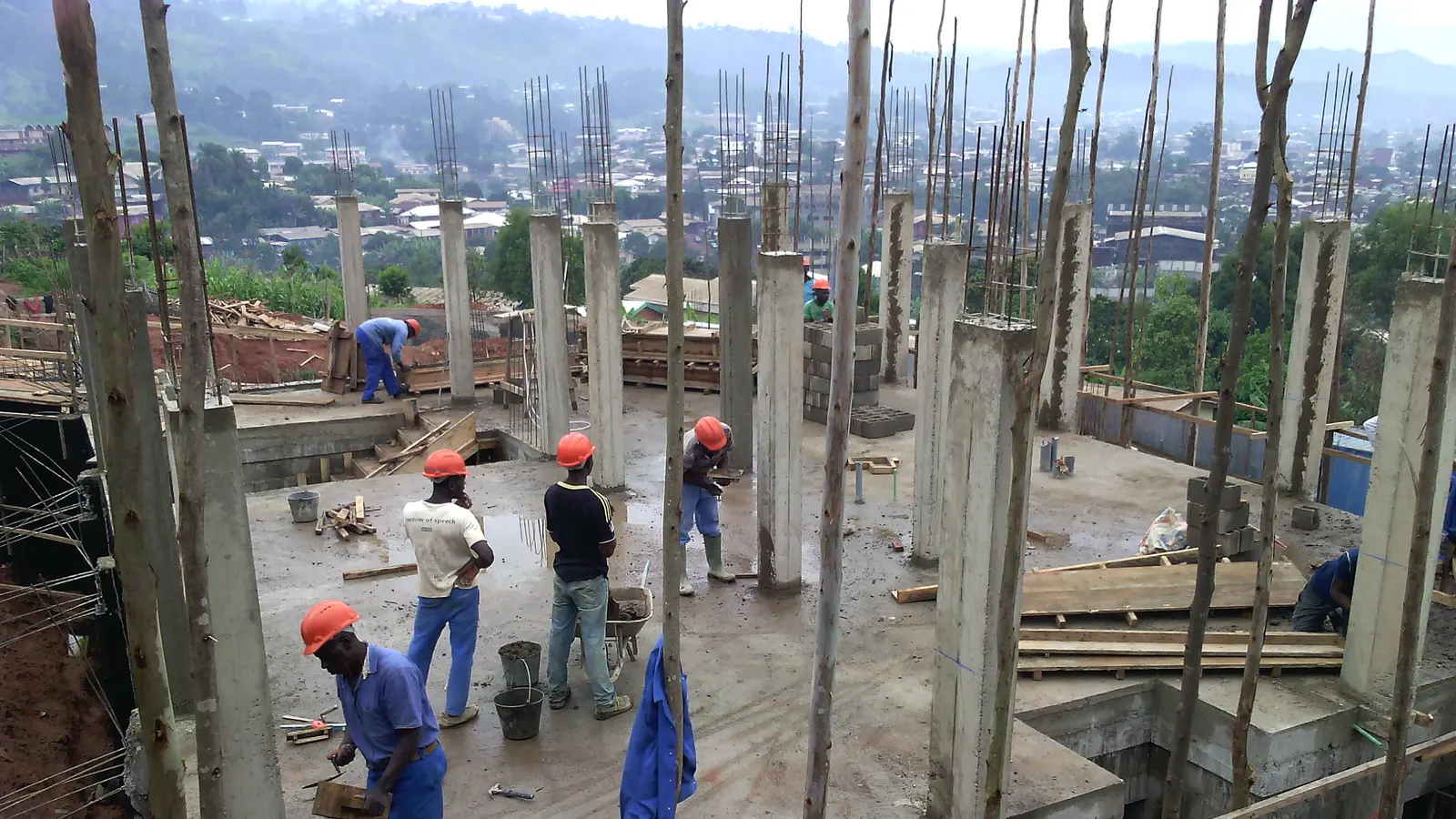

In brief
- A column that sits off its grid line puts the load away from the centre of the column and the base, which adds bending that the design may not have allowed for.
- Setting out and plumbing a column line are separate skills; a crew can hold a tape correctly and still not control verticality over two lifts.
- The cheap check is a plumb line and a tape on the starter bars before the pour, and the same check again on the completed column.
Contents
Column alignment skills gaps in Gabiley matter because a column line that drifts off its grid puts the building load away from the centre of the column and the base. That offset is eccentric loading. It adds bending to a member that the design may have assumed was carrying mostly compression. Nothing visible cracks on day one, which is why the check has to happen before the concrete goes in.
Where does the gap between setting out and plumbing a column start?
The gap opens because setting out and plumbing are two different skills, and a crew can be good at one and weak at the other. Setting out means reading the grid from the drawing, transferring it to the ground, and placing the starter bars in the right spot. Plumbing means keeping those bars and the formwork true in both directions through every lift. Holding a tape correctly proves the first. It says nothing about the second.
On a Gabiley build the grid may come from a drawing the contractor did not produce, on a plot where a previous structure or a boundary wall already fixes one line. Ask the site engineer to walk the grid with you and show the reference points, the offset from the boundary, and how the line was transferred. Request the setting-out record. Confirm with the project's structural engineer what tolerance the specification allows for verticality and position, because general practice limits differ between specifications and are not a local rule.
What does eccentric loading do to the frame above and below?
Eccentric loading moves the line of action of the load away from the centroid of the column and the base. The column then carries moment as well as axial load. The base sees a pressure distribution that is no longer uniform, and one edge of the footing carries more than the other. The beam that frames into the column can be pulled or pushed in a direction the connection was not detailed for.
The consequences depend on how far the line has moved and how the frame is braced. In a small building the reserve in the sections may absorb it. In a taller or more heavily loaded frame the extra bending can show as cracking at the column-to-beam junction, spalling at the base, or movement that appears during the next rainy season when the ground under one edge of the footing softens. Ask the structural engineer to review the as-built position against the design before the next lift is cast, and to state in writing whether the offset is acceptable.
How do you detect a misaligned column before it is covered up?
Detection is a tape, a plumb line and a record, done at three points in the cycle. First, check the starter bars against the grid before the column is formed. Measure from the established grid line to the bar in both directions and write the number down. Second, check the formwork for plumb in two directions at right angles, at the base and at the top of the lift. Third, check the finished column after striking, at the same two directions, and compare with the setting-out record.
If the numbers drift, ask who set the grid, who checked it, and whether that check is signed. Request the concrete test records and the setting-out sheet together, so the position and the material are on one file. If the crew cannot produce a setting-out record, the alignment claim rests on nothing. Then photograph the column line with the tape visible, before the next pour covers the evidence.
What to do next
Before the next column is cast in Gabiley, take a plumb line and a tape to the starter bars and record the offset from the grid in both directions. Ask the site engineer to sign that record and send it to the structural engineer with a request to confirm the position is within the specification. Keep the lift on hold until the engineer's answer arrives in writing.
Frequently asked questions
What is eccentric loading on a column?
It is what happens when the load does not pass through the centre of the column or the base. The member then carries bending as well as compression, and the footing pressure is no longer uniform across its base.
Can a misaligned column be corrected after casting?
Sometimes, but the fix is designed, not improvised. Ask the structural engineer to review the as-built position and specify the correction, whether that is local strengthening, a redesign of the connection, or acceptance of the offset within the specification tolerance.
Local reporting: this article is written for building work in Gabiley and Somaliland. Ground conditions, prices and rules differ between places; confirm the details for your own site.