(065).jpg)
In brief
- The Hargeisa Water Agency put the Kalqoray dam's capacity at 1.8 million cubic metres in a report dated 26 August 2025.
- The agency said a sand dam upstream of the main reservoir is meant to stop sand entering it, citing past dam failures from sand accumulation.
- The agency's report describes sand removal, tree clearing and a further check dam as continuing work, and it does not state a completion date for the upstream structure.
Contents
The Hargeisa Water Agency reported on 26 August 2025 that the Kalqoray dam can hold 1.8 million cubic metres of water and that a sand dam upstream of the main reservoir is built to keep sand out of it. The agency's account cites past dam failures in the region caused by sand accumulation as the reason for the upstream structure.
What the source records
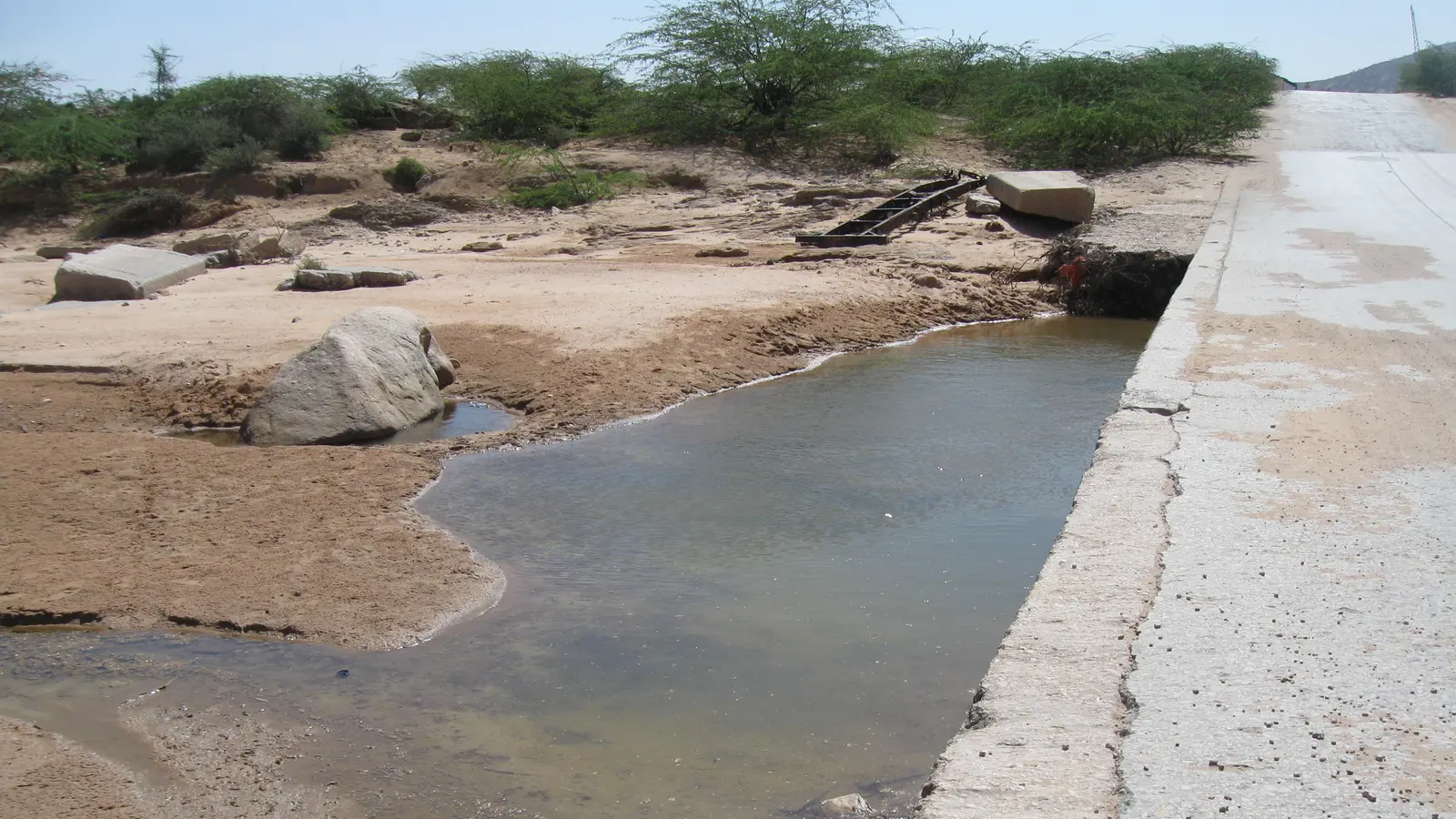
The agency states the reservoir holds 1.8 million cubic metres, a figure its General Manager, Mohamed Ali Darood, links to a review after May rainfall, when capacity was revised up from 1.4 million cubic metres. The dam site manager, Mr. Sayid, describes the sand dam as 65 metres long, with a foundation four metres deep and four metres above ground. Engineer Mohamed Saeed calls the sand dam one of the final segments of a project under way since 2022, and Engineer Khalid Daahir says the check dam should keep Kalqoray sustainable. The agency also records plans for manual sand removal, clearing short trees near the dam, a further check dam and a tourist garden. See Hargeisa Water Agency.
What it means on site
For anyone working on reservoirs or check structures in Somaliland, the mechanism is worth copying in design reviews: coarse sediment arrives with runoff, settles where velocity drops and takes storage volume with it, so a barrier is placed upstream before the reservoir. Ask the engineer for the sediment yield or sand inflow figure used to size a trap, and for the maintenance interval the design assumes. The agency's own account joins the structure to a routine: manual sand removal. Check whether the operation and maintenance plan names who removes sand, how often, and where the spoil goes, because a trap that nobody empties stops trapping.
What the source does not establish
The report does not say whether the upstream sand dam is finished and working, only that its construction was completed efficiently and that more may be needed. It does not give a current measured storage volume for the reservoir, a survey of how much sand has already settled, or a completion date for the further check dam or the garden. Sand removal is described as part of ongoing management, without a schedule. As of 26 August 2025 the evidence is the agency's own account; a bathymetric survey, as-built drawings and an operations log would confirm the present state.
What to do next
Before designing a similar trap, ask the Hargeisa Water Agency water resources office for the Kalqoray sediment data, the sand dam as-built drawings and the maintenance record, and ask the municipal engineer's office whether any local check dam has been surveyed after a rainy season.
Sources
Local reporting: this article is written for building work in Hargeisa and Somaliland. Ground conditions, prices and rules differ between places; confirm the details for your own site.