In brief
- Salt-laden humid air along Somaliland's coast, especially around Berbera, drives chloride into concrete and corrodes reinforcing steel far faster than in dry inland towns like Hargeisa.
- Coastal concrete elements need roughly 40 to 50 millimeters of cover over the reinforcement, compared with 20 to 25 millimeters typical for inland work.
- A water-cement ratio at or below about 0.45 to 0.50, combined with at least seven days of wet curing, produces denser concrete that slows chloride penetration.
- Galvanized or epoxy-coated rebar, typically 25 to 50 percent more expensive than ordinary black bar, is worth specifying for elements that face the sea directly, such as seafront parapets and boundary walls.
- Brackish coastal water and unwashed beach sand should never go into the concrete mix or the curing process, because they introduce chloride next to the steel regardless of cover or coating.
Contents
- Why Does Salt Air Corrode Rebar Faster in Berbera Than Inland?
- How Much Concrete Cover Do Coastal Buildings Need?
- Should You Pay for Galvanized or Epoxy-Coated Rebar?
- What Water-Cement Ratio and Curing Schedule Cut Corrosion Risk?
- What Other Design and Maintenance Choices Protect a Coastal Building?
- What to do next
Reinforced concrete along Somaliland's Gulf of Aden coast, particularly in Berbera, Zeila and Lughaya, corrodes faster than the same concrete built inland in Hargeisa or Burao, because salt-laden humid air drives chloride into the pores of the concrete and attacks the steel bars inside it. The fix is not one product; it is a combination of thicker concrete cover over the reinforcement, about 40 to 50 millimeters instead of the 20 to 25 millimeters common inland, a denser mix with a low water-cement ratio, proper wet curing in the heat, and, for elements that face the sea directly, galvanized or epoxy-coated bar. None of these steps is exotic or expensive on its own. Skipping them is what turns a beam that should last forty years into one that spalls and exposes rusted steel within fifteen.
Why Does Salt Air Corrode Rebar Faster in Berbera Than Inland?
Steel reinforcement is protected inside concrete by a thin, naturally forming layer of iron oxide, and that layer holds as long as the surrounding concrete stays alkaline and free of chloride. Humid, salt-laden air breaks that protection down faster than almost any other exposure. In Berbera, moisture off the Gulf of Aden carries fine salt particles that settle on exposed concrete and migrate through its pores toward the bars inside it (Keystone Engineering & Consulting).
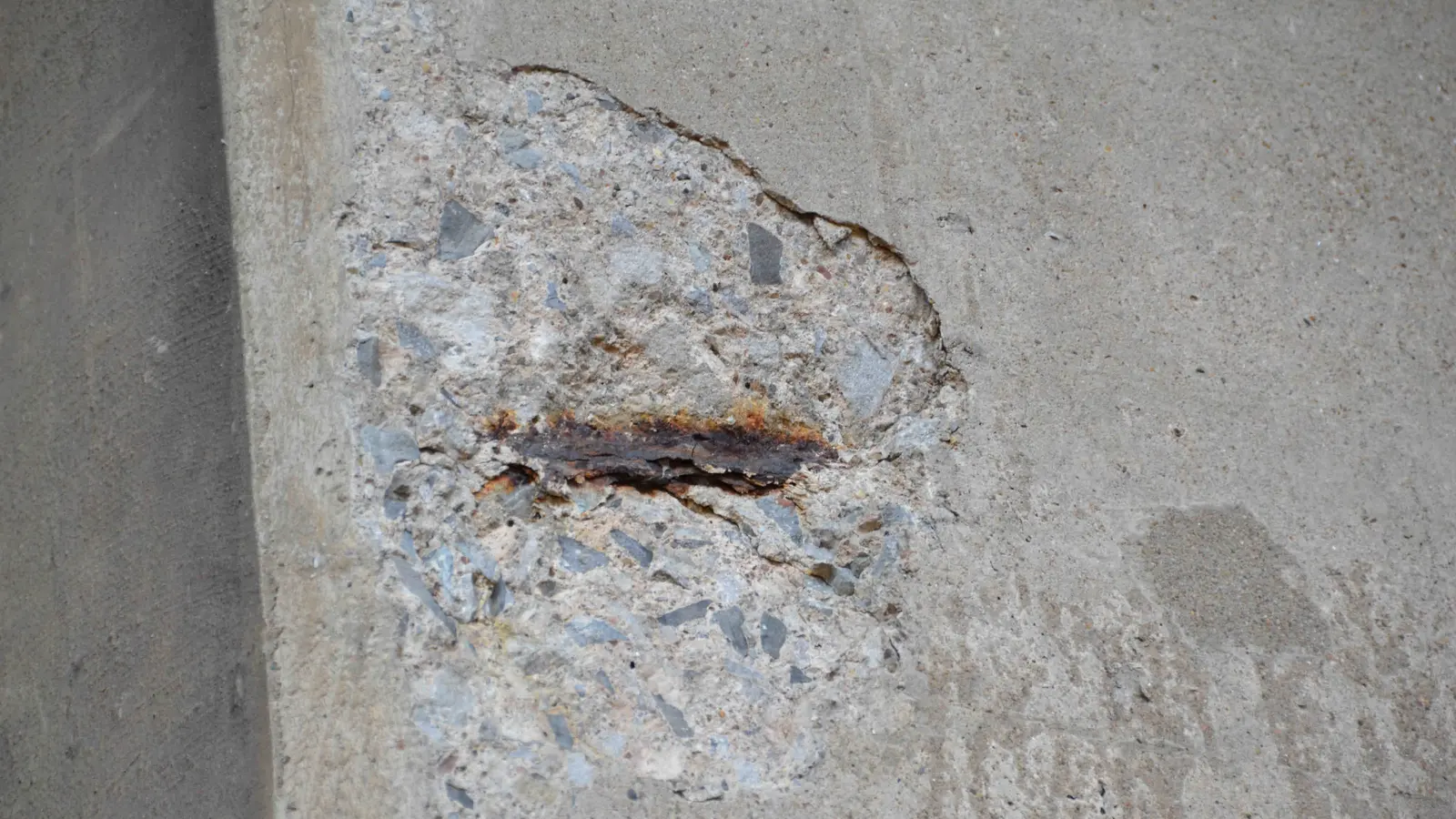
Once enough chloride reaches the steel, the passive layer fails and rust starts to form. Rust takes up several times the volume of the steel it replaces, so the expanding metal cracks the surrounding concrete from the inside, opening a path for more air, moisture and salt to follow (Kairali TMT). Berbera's hot Xagaa-season wind carries salt spray well beyond the waterfront, and the heat speeds up every stage of the reaction. That combination is why boundary walls, ground beams and columns near the port show rust stains and hairline cracking years before comparable work in Hargeisa's dry inland climate.
How Much Concrete Cover Do Coastal Buildings Need?
Coastal structural elements need roughly 40 to 50 millimeters of concrete cover over the reinforcement, compared with the 20 to 25 millimeters that is typical for dry, inland work in Hargeisa or Burao. Cover is the thickness of solid concrete between the outer face of a member and the nearest steel bar, and it is the cheapest defense against chloride attack available, because it costs extra concrete rather than extra steel.
The elements that need the most cover are the ones most directly exposed: seafront parapets, boundary walls facing the water, ground beams and foundations in areas with a high water table, and any water tank or cistern. A rough guide, adapted from general reinforced concrete durability practice rather than a Somaliland-specific regulation, looks like this:
| Element | Typical inland cover (Hargeisa, Burao) | Coastal cover (Berbera, Zeila) |
|---|---|---|
| Slabs, internal walls | 20-25 mm | 30-40 mm |
| Beams, columns | 25-30 mm | 40-50 mm |
| Foundations, ground beams, tanks | 40-50 mm | 50-65 mm |
Getting this right on site is mostly a matter of using plastic or mortar spacers to hold the reinforcement cage off the formwork at the correct distance, rather than letting bars sag onto the shutter, which is a common and easily avoided fault on small sites.
Should You Pay for Galvanized or Epoxy-Coated Rebar?
Only for the elements that face the sea most directly. Hot-dip galvanized rebar typically costs 25 to 50 percent more than ordinary black bar, a range that reflects general galvanizing cost guidance rather than a Somaliland-specific price list (galvanizedrebar.com), and epoxy-coated bar sits in a similar range. For a seafront parapet or boundary wall in Berbera, that premium is worth paying, because the alternative is cutting out and replacing corroded steel and re-plastering the wall within a decade or two.
For a house or shop set back from the shoreline, or for inland work in Hargeisa and Burao, the same money is usually better spent on denser concrete and correct cover, since the salt exposure is far lower to begin with. Epoxy-coated bar also needs careful handling: a nick or scrape during bending, transport or fixing exposes bare steel at exactly the point where the coating was meant to protect it, and that damaged spot corrodes anyway. Galvanized bar tolerates rough site handling better, which matters on projects where formal quality control is limited. Stainless steel reinforcement resists chloride almost completely, but its cost puts it in the range of port infrastructure and major bridges, not ordinary buildings.
What Water-Cement Ratio and Curing Schedule Cut Corrosion Risk?
Keep the water-cement ratio at or below about 0.45 to 0.50, and cure every coastal pour with wet hessian, sacking or ponding for at least seven days, longer where it is practical. A lower water-cement ratio produces a denser cement paste with fewer connected pores, which slows how fast chloride and moisture can reach the steel, a principle used in performance-based concrete specifications for chloride exposure worldwide (NRMCA).
Berbera's heat makes curing more urgent, not less. Fast evaporation from direct sun and wind can dry out the surface of a slab or wall before it has properly hydrated, leaving fine plastic-shrinkage cracks that give salt a shortcut straight to the reinforcement. Watering exposed concrete at least twice a day, morning and evening, for the first week matters more in this climate than in a cooler one.
What Other Design and Maintenance Choices Protect a Coastal Building?
Detailing that keeps water and salt moving away from the structure matters as much as the concrete mix itself. Drip grooves under window sills and copings stop rainwater and dew from tracking back under a ledge and carrying dissolved salt into the wall face below. Roof drainage should discharge well clear of walls and foundations rather than sheeting down the facade, and flat parapets that trap standing water and salt spray are worth avoiding in favor of a slight fall and a proper drip edge.
A dense cement-based render, or a paint system made for coastal exposure, slows salt penetration into the wall behind it, but only if it is reapplied on a maintenance cycle rather than treated as a one-time job. Routine inspection catches problems early: a rust stain bleeding through paint, or a hairline crack running along the line of a hidden bar, is the first sign of trouble, and cutting out and patching that small area costs far less than waiting for the concrete around it to spall. Berbera's port structures use heavier corrosion control, including specialist coatings and cathodic protection, that is justified for large marine infrastructure but unnecessary and too costly for a house, shop or warehouse. Ordinary buildings get most of the same protection from correct cover, mix design and upkeep alone.
What to do next
Before the next pour on a coastal plot in Berbera, Zeila or Lughaya, put three numbers in writing in the contract with the mason or contractor: minimum concrete cover for each element, maximum water-cement ratio, and minimum curing days with wet covering. Ask a local engineer, or a materials testing lab if one is available, to check a trial mix before the main pour rather than after. If the plot sits within a few hundred meters of the shoreline, or draws water from a coastal borehole, have that water checked for salinity before it goes anywhere near the mixer. These checks cost little next to the price of re-plastering a rusted wall in ten years, and they are the difference between a building that ages like Hargeisa's dry-climate stock and one that needs structural repair while it is still being paid for.
Frequently asked questions
How long before corrosion problems show up in an unprotected coastal building in Somaliland?
No Somaliland-specific study tracks this, but the same chloride-ingress principles used worldwide suggest a plausible range: an unprotected wall directly exposed to sea air in Berbera can show rust staining and cracking within ten to fifteen years, while the same mix built inland in Hargeisa can last several decades before the same symptoms appear. Extra cover, a lower water-cement ratio and full curing push that coastal timeline out substantially.
Does painting a wall stop salt from reaching the rebar?
Paint and render slow moisture and salt penetration but do not stop it if the cover and mix underneath are inadequate. A dense cement render with a waterproofing additive, reapplied on a regular cycle, helps more than a decorative paint alone, but neither substitutes for correct cover and curing at the time of the pour.
Is it cheaper to prevent corrosion or repair it later?
Prevention is cheaper. Extra concrete cover and a properly cured, lower water-cement mix add a small amount to the cost of a pour, while cutting out corroded steel and re-casting a spalled beam or column later involves demolition, temporary propping and full reinstatement of that member.
Can beach sand or coastal borehole water be used in concrete near Berbera?
Beach sand often carries salt and shell fragments and should be washed and tested before use, and brackish coastal borehole water should not go into the mix or the curing process at all, since both put chloride next to the steel regardless of how much cover is specified.
Sources
- How Salt Air Impacts Concrete, Steel, and Roofing Systems - Keystone Engineering & Consulting
- How Salt-Laden Air Causes Steel Corrosion - Kairali TMT
- FAQs - Galvanized Rebar
- Performance-Based Specifications for Concrete Exposed to Chlorides - NRMCA
- Berbera, aka Barbara - Coastal city in the Sahil region of Somaliland
- Berbera Cement Factory
Local reporting: this article is written for building work in Berbera. Ground conditions, prices and rules differ between places; confirm the details for your own site.
Photo: Achim Hering, CC BY 3.0, via Wikimedia Commons
