In brief
- Somaliland has no licensing exam or trade certificate for masons and steel fixers, so skills pass from mentor to apprentice purely by imitation over one to three years.
- Curing gets skipped because it costs water and time, and once an apprentice never sees it done, he assumes concrete does not need it, even though ACI guidance calls for at least seven days of moist curing.
- Rebar cover is invisible once concrete is poured, so a mentor who never used spacer blocks teaches an apprentice to lay steel by feel, producing cover that ranges from zero to inconsistent in the same slab.
- Mixes are measured by shovel count from memory rather than by weight or a fixed water-cement ratio, so identical-looking batches can differ widely in final strength.
- The same system that transmits these faults also builds genuinely fast, accurate hand skills, so the fix is teaching the reasoning behind techniques, not replacing the apprenticeship model itself.
Contents
Somaliland has almost no formal vocational pipeline for masons, steel fixers, or concrete finishers, so most builders learn their trade the way their mentor did: by watching, copying, and repeating whatever that mentor did on site. This transfers real physical skill well, laying a straight block course, tying a stirrup, reading a spirit level, but it also transfers every shortcut and misunderstanding the mentor picked up along the way. A foreman who never learned why concrete needs days of wet curing will not teach an apprentice to cure it. A mason who has always eyeballed a mix by shovel count will pass that same guess to the next crew. Somaliland has no unified building code and no government site inspection regime, according to researchers who studied construction practices in Hargeisa, so there is rarely a second opinion to catch an error before it becomes someone's standard method.
How Does the Informal Apprenticeship System Actually Work?
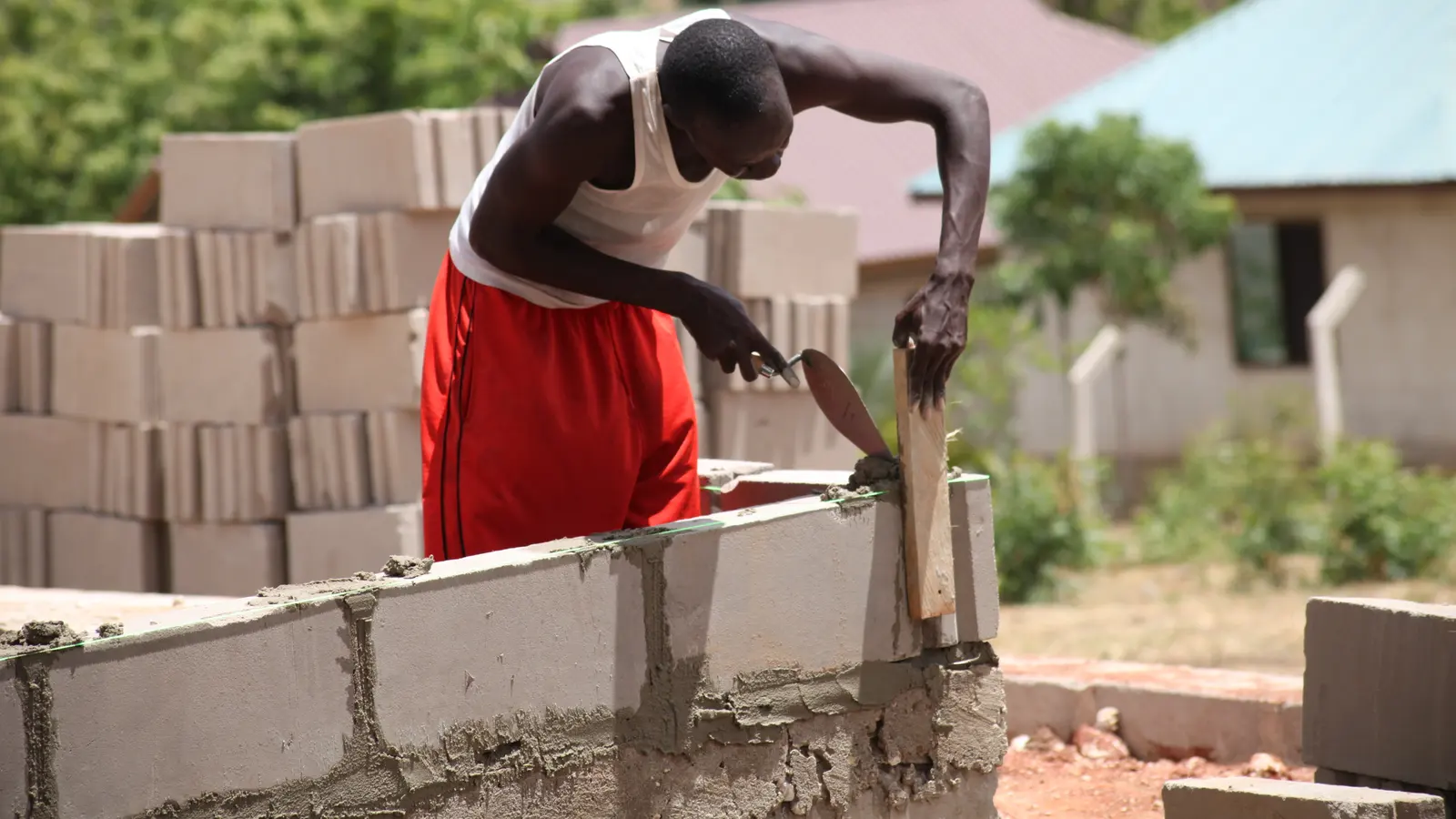
A young laborer attaches himself to a foreman, often called a mu'allim, and learns by proximity over one to three years, with no curriculum, no written test, and no certificate at the end. He starts by carrying blocks and mixing concrete by hand shovel, and gradually takes on tying steel, building formwork, and laying block as the foreman lets him. Because contractors in Somaliland rely mainly on personal judgment and experience rather than a shared code, according to a study of Hargeisa practitioners' perceptions of local building practices, what the apprentice absorbs is that one foreman's judgment, not a broader standard. Most residential jobs run from a rough sketch or the foreman's memory of dimensions rather than structural drawings, so the apprentice rarely sees a drawing at all. He learns to judge concrete readiness by how it looks on the shovel, to place steel by feel, and to time formwork removal by habit. After a year or two he can run his own small crew, using exactly the techniques he watched, correct or not.
Why Does Poor Curing Become a Generational Habit?
Curing is usually the first thing a mentor cuts under time or water pressure, so the apprentice never sees it done and assumes concrete does not need it. Concrete gains most of its strength through hydration, a chemical reaction between cement and water that keeps working for weeks after casting, and if the surface dries out in the first days, that reaction stops early and the concrete never reaches its design strength. In Hargeisa's dry heat an exposed slab can visibly dry within hours of finishing, long before hydration is anywhere near complete, which is a sharper problem inland than on the humid coast. Standard practice calls for keeping concrete moist for a minimum of about seven days, covering it with wet sacks, hessian, or polythene sheeting, or ponding water on flat surfaces. On a typical Somaliland site, curing gets skipped because trucking water to a residential plot costs money, the crew is needed on the next job, and no one has ever run a strength test to compare a cured slab against an uncured one. A foreman who has cut curing on his last ten jobs without a visible collapse concludes it does not matter, and the crack or spall that shows up two years later is never traced back to the pour.
Why Do Apprentices Learn to Skip Rebar Cover?
Cover disappears from view the moment concrete is poured, so a mentor who never used spacer blocks teaches his apprentice to lay steel directly on the formwork by feel. Cover exists to keep reinforcing steel embedded far enough from the surface that moisture, salt, and carbon dioxide take years rather than months to reach it and start corrosion, and it also gives the steel enough concrete around it to grip properly and to survive a fire. Under ACI 318, footings cast directly against soil need about 75 millimeters of cover, and slabs that are not exposed to weather need only about 20 millimeters, a wide range that a crew has no way to hit consistently without measuring. On most Somaliland sites, steel gets tied and laid straight on the ground or formwork, sometimes propped on broken tile chips or stones of whatever size is lying around, so cover in a single slab can run from nothing to well over what is needed. Plastic cover spacers, cheap and common in hardware shops elsewhere, are not always stocked in Hargeisa, and even where they are available, crews are often never shown to use them because their own mentor never used them either. The rust stains that streak down balcony undersides and stair soffits around Hargeisa a few years after construction are often the visible result of this one habit.
Why Are Mixes Eyeballed Instead of Measured?
Mentors teach concrete ratios as a shovel count from memory rather than a measured recipe, so water content and strength drift from batch to batch with nothing checking either. The ratio usually taught, something close to one shovel of cement to two of sand to four of gravel, is a reasonable starting point, but a shovel load varies with how full each worker fills the blade, and water goes in by eye and feel instead of a fixed water-cement ratio. No batching by weight, no slump test, and no cube test happen on the typical small residential job, not because a crew rejects them but because the apprentice never saw them done and does not know they exist as a way to check the work. A wetter mix pours and finishes more easily under time pressure, so apprentices learn to add water until the job gets easier, which quietly weakens the concrete, and because the mentor did the same thing for years without a visible failure, the next generation repeats it without question.
What Strengths Does the Informal System Actually Have?
The same system that transmits these faults produces genuinely fast, accurate hand skills, because repetition under a demanding mentor builds physical competence that a classroom alone does not. Many Hargeisa crew leaders can lay a straight, plumb block wall faster than a graduate with no site hours behind him, and the apprenticeship model has almost no entry cost for a young man with no capital, which keeps construction labor accessible in a market with a thin formal training pipeline. It also keeps practical knowledge circulating inside the local workforce rather than sending it abroad. Its weakness is narrow but consistent: it copies everything the mentor does, good and bad, with no outside check, so it never corrects itself unless someone deliberately teaches the reasoning behind a technique, curing chemistry, cover requirements, mix design, rather than just the motion of doing it.
What to do next
If you are hiring a crew or supervising your own build, do not assume a foreman's habits are safe just because he has years on site. Before the first pour, ask him specifically what curing method he will use and for how many days, and put that answer in the contract rather than trusting it will happen by default. Ask to see rebar spacers in place before concrete goes in, not after, since cover cannot be checked once it is poured. If you cannot afford a supervising engineer for the full build, hire one for a same-day spot check at the footing and slab pours only, since that costs far less than repairing cracked or spalled concrete later. A simple written checklist agreed with your foreman before work starts breaks the unspoken assumption that his usual method is automatically the right one.
Frequently asked questions
Is there any formal masonry or rebar training available in Somaliland?
Formal vocational programs are limited and not widely used by the residential construction sector, so most masons, steel fixers, and formwork carpenters still learn entirely on the job under an experienced foreman. A few NGO and donor-funded training initiatives exist periodically, but they reach a small share of the workforce compared to the informal apprenticeship route.
How long should freshly poured concrete be cured in Somaliland's climate?
A minimum of about seven days of continuous moist curing is standard guidance for ordinary structural concrete, and inland locations like Hargeisa need it enforced more strictly because the dry heat can dry an exposed surface within hours. Covering with wet sacking, hessian, or polythene sheeting, or ponding water on flat slabs, are the simplest methods available on a typical site.
How can a homeowner check rebar cover without an engineer on site?
Ask the crew to place plastic or precast concrete spacer blocks under and around the steel cage before the pour, and physically look at the gap between the steel and the formwork on all sides, not just the top. A rough rule of thumb is at least 20 millimeters for slabs away from weather and closer to 75 millimeters for anything cast directly against soil, such as footings.
Why don't crews just switch to measured, weighed concrete mixes?
Weighing scales and standardized batching boxes are rarely available on small residential sites, and the shovel-ratio method is what every apprentice has been taught to trust, so switching requires the foreman to actively unlearn a habit rather than simply be told a better one exists. A basic gauge box that fixes shovel volume is a low-cost first step.
Sources
Local reporting: this article is written for building work in Somaliland. Ground conditions, prices and rules differ between places; confirm the details for your own site.
Photo: Ash Gallery, CC BY-SA 4.0, via Wikimedia Commons
